read time • 10 mins
Railroading’s Transition to Telematics: A Lot Can Happen in Four Years (Part 1)
Telegraph’s 4-part series looking ahead to the future of telematics-enabled freight railroading in the United States.
This is the first installment in Telegraph’s 4-part blog series, Railroading’s Transition to Telematics. In each installment, we deep dive into the state of railcar telematics in the US, and make our case for a better future state.
“We’ve got to get into the 21st century here”
Railroading stands on the precipice of a great, and potentially rapid, technological transformation. But, you could be forgiven for missing it. After all, as an industry, we’ve been on hold at this particular technological juncture for a decade or more. Of course, we’re talking about the introduction of modern GPS-enabled rail car visibility with onboard telematics devices. In this blog series, we’ll lay out a plausible timeline to adoption, and envision the opportunities that telematics will unlock both for early adopters and experimenters, as well as, with time, the fully digitally inter-connected rail network.
Other freight modes – truck, ocean shipping, air cargo – have all already taken the technological step before us. Railroading’s reluctance to similarly evolve has not gone unnoticed. Even at the highest levels of American governance, concern is growing. In his 2025 comments before the US House Transportation & Infrastructure Committee, Congressman Seth Moulton (D-MA) proclaimed, “We’ve got to get into the 21st century here… It’s absurd that I can spend $10 on Amazon and know exactly where my shipment is, but if I spend $20k to ship a rail car, I have no idea when it will arrive – that is absurd!” [1]
This technology is already ubiquitous. It’s already on cargo-carrying trucks, planes and ocean-faring vessels. It’s already in passenger vehicles. It’s already in your smartphone! In this first installment in our blog series, Railroading’s Transition to Telematics, we consider the question: how long until we see telematics on our railcars too?
A lot can happen in four years.
One obstacle to widespread adoption of telematics in railroading is the scale of the challenge. There are approximately 1.6 million railcars in circulation in the United States today. They are in motion all over the country, and are owned by a broad mix of stakeholders, including the railroads themselves, as well as shippers and railcar lessors. It is a fair question then to ask: how would we possibly even equip each one of these railcars with new hardware? Who would bear that cost?
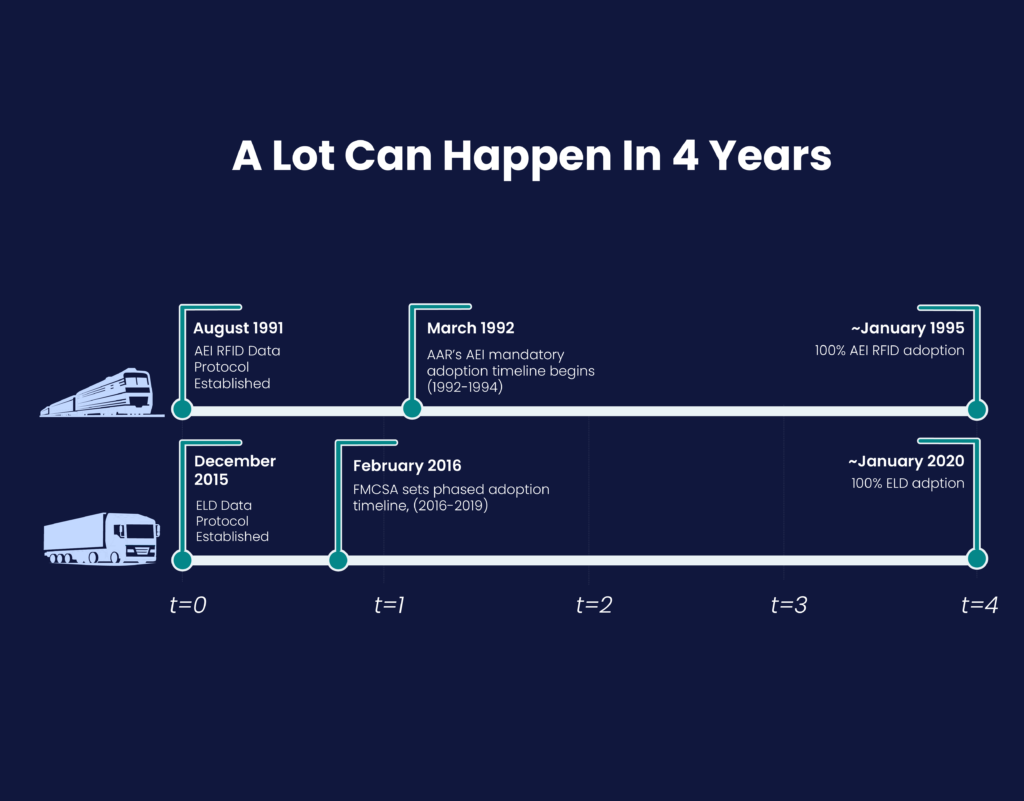
In our view, we needn’t answer those specific questions right now in order to first get a sense of the imminent feasibility of the transformation before us. Instead, we can look to the past. Has something like this ever been done before? It has! When we look back at the recent history of widespread technological transformation in logistics, we can see that such a feat has indeed been achieved before – twice! And, each time, from start to finish, the revolution took only four years.
Example 1: RFID on railcars (1991 through 1994)
In 2025, we are not the first generation of people who want to know where our railcars are. Nor are we the first with access to technology for solving this problem. Beginning in the 1980s, railroads began experimenting with radio frequency identification (RFID) technology. RFID technology transmits radio wave signals between programmable RFID tags and RFID readers. In the context of railroading, railcars equipped with RFID tags pass by RFID readers installed next to railroad tracks. The tags contain information about the railcar, and each reader identifies a specific location on the tracks. Combined, the RFID tag and reader can broadcast which railcar passed which reader at what time (with an approximately 6+ hour time lag). [2]
Railroads’ early experiments with RFID (known within the industry as Automatic Equipment Identification, AEI) proved a success. As a result of these successes, industry leaders of the 1980s and 1990s came together to devise a plan to equip the entire American railcar fleet with RFID technology. After a few years of planning, in 1991, the American Association of Railroads (AAR) – which, among other things, manages how competing railroads track their shared resources through its ‘interchange service’ – stipulated that by the end of 1994, only RFID-enabled railcars would be eligible for interchange service. In essence, the AAR introduced a powerful forcing mechanism on the industry that triggered the railroads’ technological evolution: upgrade to RFID, or lose access to the full railroad network.
By January 1995, virtually all of the cross-country circulating railcars at that time were RFID-equipped, at a reported cost of $60-$80 per railcar for an RFID tag set , plus $200 installation.[2] A lot can happen in four years.
Example 2: Electronic Logging Devices on Freight Trucks (2015 through 2019)
Of course, people moving freight on trucks want to know where their freight is too. However, trucks operate in conditions that make RFID technology impractical for this use case. There are simply more highway miles criss-crossing America (approximately 4.2mn miles) than there are miles of railroad track in our country (~140K). Installing fixed RFID readers to cover the entire American road network in order to pick up passing trucks’ RFID tags was simply impractical and cost-prohibitive at scale.
Luckily for all of us, technology advanced between the 1990s and 2000s to meet trucking’s operating environment. The proliferation of affordable, everyday-use Global Positioning Systems (GPS) changed everything. Scalable and modern GPS units – and the satellite networks with which they communicate – enable users to geolocate themselves in realtime, from almost anywhere (except tunnels!). This is the technology in your phone that can put you on a city map instantly and also chart directions for you to anywhere. Before GPS came to live natively in our phones and in our vehicles, many of us purchased stand-alone bolt-on GPS devices. (Remember TomTom? My family had one and we named her Marge! I miss Marge…)
In 2012, as part of the Obama administration’s broader legislative package known as the “Moving Ahead for Progress in the 21st Century Act” (MAP-21), the federal government imposed a mandate that required the installation of a particular breed of GPS-enabled telematics technology known as Electronic Logging Devices (ELDs) on all freight-carrying trucks operating in the United States. Mandate-compliant ELDs were required to periodically record: (1) the GPS location of the truck; and (2) the truck driver’s real-time compliance with federal rules on maximum allowable daily driving hours for truckers.
Similar to the AAR’s timeline, the MAP-21 legislation first gave regulators and the industry a few years to formulate the rules, standards, and technical protocols necessary for compliance. In 2015, the 4-year transition period began. With very limited exceptions, full compliance was achieved by the end of 2019 at an approximate cost of $200 to $2000 per unit, plus $30 to $60 monthly subscription fees. [3] A lot can happen in four years.
Will This Be Our Year?
Telematics in railroading is a lot like level 4 autonomy in trucking: for each of the last ten years, pundits have been predicting that this brave new world will become a reality in the next five years. But, alas, it never has. Not yet, anyway. In reality, both industries have been standing on the precipice of our respective technological transformations for the better part of a decade. Will this be our year?
Looking back at the historical analogues discussed in this post, it is important to note that both were catalyzed by a forcing mechanism: AAR’s requirement that railcars be equipped with RFID technology or risk losing access to interchange networks in 1991; and the federal government’s mandate that trucks be equipped with ELD technology or risk being pulled off the road in 2015. Accordingly, the first question is: Is there a similar kind of forcing mechanism on the horizon in 2026?
There does not appear to be interest in a railroad telematics mandate amongst the sitting members of the 119th Congress. Instead, there appears to be bi-partisan support for a railcar telematics subsidy. The American Tank Car Modernization Act of 2025 was introduced by Troy Neihls (R-TX), and co-sponsored across-the-aisle by Seth Moulton (D-MA), and Jim Costa (D-CA). This program would set aside $10mn in annual grant funding to subsidize the installation of telematics devices on tank cars. This makes sense because tank cars often carry hazardous and high-value commodities.
Similarly, today’s AAR appears more interested in supporting railroad telematics adoption than in using its own leverage to force a technological upgrade. Through its subsidiary Railinc, the AAR provides backend data storage support to the RailPulse coalition. RailPulse is a separate consortium of companies who have come together to standardize railcar telematics data collection, storage, and transmission going forward. The RailPulse project represents a critical first step towards realizing the benefits of telematics-enabled railroading. To-date, RailPulse has on-boarded over 20k telematics-enabled railcars to its system.[4]
So, the answer is no. At present, none of our industry’s usual suspects are holding up their starter’s pistol to signal a new 4-year sprint toward American railroad modernity. But should they be? In this blog series we will make the ‘for’ case. First, we will describe the opportunities that we think telematics can unlock in the first two years of our industry’s transition to telematics. After that, we will consider years three, four, and beyond.
In our next installment (post #2), we will describe the benefits that can accrue for shippers, railroads, and railcar owners from telematics – even when adopted only in small numbers and in localized experiments, as is the case today. We’ll draw on our team’s extensive experiences with trucking’s telematics transformation to envision and describe the tangible benefits that early adopters can expect during the first two years of railroading’s pending transition to telematics.
In blog post #3, we will lay out our insider’s vision of modern, digitally-interconnected railroading when more than half of the country’s railcar fleet is equipped with digital telematics devices that communicate with one another and with dedicated artificial intelligence (AI) tools. As technologists, we will envision and describe the potential benefits of a fully integrated, digitally traceable, and thereby optimizable rail freight network for the United States.
Ten years is a long time to kick the tires – or in this case, the wheels of steel! – on an important decision. Arguably, too long. This blog series will make the case for expediting railroading’s reluctant transition to telematics. This could be our year. It’s taken a long time to come.
Notes:
[1] US House Committee on Transportation & Infrastructure Hearing, America Builds: The Role of Innovation and Technology in a Safe and Efficient Rail System – June 24 2025https://www.youtube.com/watch?v=OYv1NkzDMFA
[2] “Real-Time Tracking: What Are We Waiting For? By Robert H. Cantwell for Railway Age, February 2, 2023. https://www.railwayage.com/cs/real-time-tracking-what-are-we-waiting-for/
[3] “ELD Mandate Will Increase Costs”. By Ashley Cruz for Fleet Owner. July 31, 2017. https://www.fleetowner.com/for-the-driver/on-the-road/article/21185128/eld-mandate-will-increase-costs
[4] RailPulse Webinar: Turning Data into Action. September 25 2025. https://www.youtube.com/watch?v=NnX7Ampu7g8
About the Author

David Correll is the Director of Freight Market Intelligence at Telegraph. He has spent two decades in transportation and logistics with the US Department of Transportation, the US Department of Energy, the Massachusetts Institute of Technology, and Clark University. David brings his many experiences – and a little bit of wit – to help us break down some of the more nuanced challenges and opportunities facing American rail transportation.