read time • 10 mins
Why Can’t Railroads Just Be Friends?: How Interlines, Trackage Rights, and Smart Cooperation Move Freight Without Mergers
Anytime your freight moves, it traverses mostly public lands. Planes in the sky, and ships in the sea move through vast border-spanning spaces that are governed, but never owned. Freight trucks also operate almost exclusively within America’s state and federal highways, only touching private property on the very margins of their journeys.
American freight rail is an entirely different ballgame. Railroad companies – from Class I’s to shortlines – own all the train tracks. Furthermore, almost no new freight rail tracks have been built in this country since World War I. Moreover, in the vast majority of cases, American railroads are entitled to operate their tracks with exclusivity. These peculiar quirks of rail freight conveyance explain a lot – especially given the fact that no single railroad currently owns enough contiguous miles of track to carry freight coast-to-coast…enter the headline-making transcontinental railroad merger between Union Pacific (UP) in the West, and Norfolk Southern (NS) in the East, first proposed in July 2025.
In light of all the recent UP-NS merger speculation, this blog gives a quick primer on the existing ways that railroads can share track with one another, short of merging. In modern supply chains, there are a myriad of ways in which even the most self-interested competitors can find mutually-beneficial ways of working together to get things done cheaper, better and faster. Such clever ingenuity is what Leonard Read called supply chains’ “configuration of creative human energies” in his classic 1958 essay, I, Pencil; and my friend Dr. Yossi Sheffi dubbed “the daily miracle” in his most recent book, The Magic Conveyor Belt: Supply Chains, AI and the Future of Work. Of course, approaching the question in this way naturally leads us to the inevitable question – so why then merge at all?
Mechanisms for Cooperation
Trackage Rights
Imagine, for example, that you own a railroad that needs to get from point A to point B, but you do not own the track that connects the two. But…another railroad does. In this case, a straightforward solution would be to pay the other railroad for the privilege of sending your trains across that specific run of their track. In American railroading, this arrangement is called “trackage rights”, or the right to run your trains across a specific piece of another railroad’s network.
Trackage rights come in two flavors – one which grants only the right to run your train along the competitor’s track, but not to service customers along the way (known as “Overhead Trackage” or “Bridge Trackage); and another, rarer version (“Full Service” or “Local Trackage”), which allows you to stop and serve customers along the way, too. The amount of trackage rights miles utilized by American railroads depends upon the specifics of each railroad’s network, but Class I trackage rights typically account for between 15% to 30% of total network miles.
Trackage Rights In Practice
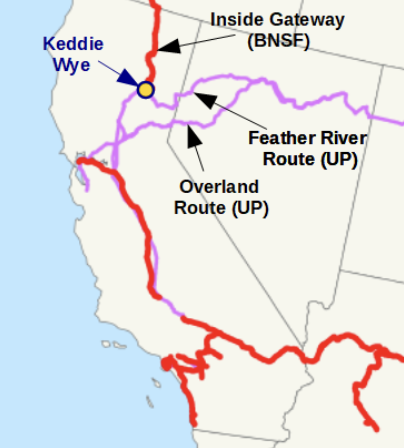
A classic example of an active trackage rights agreement in the United States is the one between UP and BNSF in northern California’s Feather River Canyon area. In this case, mergers and acquisitions in the early 20th century left BNSF (shown in red on the right) with a disconnected network between Stockton and Keddie, California. As a competition-preserving condition for approval of UP’s own 1996 merger with Southern Pacific, UP granted BNSF overhead trackage rights along this roughly 200-mile stretch of track. (See map at right).

Haulage Rights
Now, consider a different solution. Again, you need to get from point A to point B, and you don’t own the track that connects these two points. But… again, a neighbor railroad does. Another way to solve this problem is to simply hire the other railroad to complete the part of your freight’s journey that traverses their network. In essence, your railroad still bills your shipper for the whole move from A to B – but under a haulage rights agreement, you pay out some of that fee to your neighbor railroad, who handles the part of the move that takes place on their network. Haulage rights agreements are generally considered to be less common than trackage rights agreements. By some estimates, only 3% to 5% of American railborne freight moves via hauling rights agreements between railroads. This is, in part, because under a haulage rights agreement, you lose operational control over the move. Your ability to service your customers is at the mercy of the sub-contracted neighbor railroad who performs that work for you.
Haulage Rights in Practice
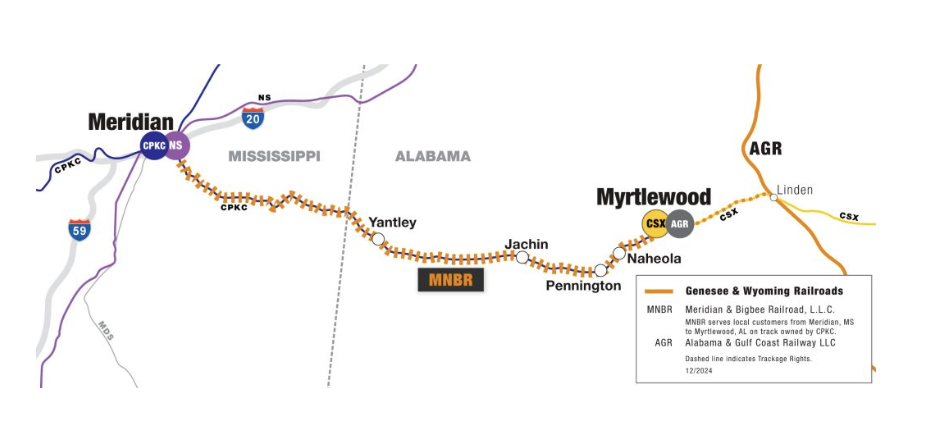
An important haulage rights agreement once existed between CSX and shortline railroad Genesee & Wyoming (G&W). Under this agreement, CSX paid G&W to move railcars 150 miles from Meridian, Mississippi to Montgomery Alabama on a stretch of G&W track known as the Meridian & Bigbee railroad (MNBR). This haulage rights agreement allowed CSX to junction with CPKC near Montgomery in an “interline agreement” (see below). However, in November 2024, both CSX and CPKC received approval from the Surface Transportation Board (STB) to acquire from G&W two contiguous pieces of the MNBR, thereby mooting the haulage agreement with G&W, and affording each of the Class I’s more operational control.
[Image source: https://www.gwrr.com/mnbr/]
Interline Agreements
Now, imagine a different situation. You now have a customer at point A, say on the West Coast, who wants to send something way out of your network to point B… 1,000 miles away on the East Coast. Your company again does not own track anywhere near point B. But, you know of another railroad out East who services point B. In this case, the solution is an interline agreement.
You pick up from your customer at Point A on the West Coast, carry their freight to the edge of your network, and then hand the load off to your partner railroad, who takes it the rest of the way to point B on the East Coast.
Interline Agreements in Practice
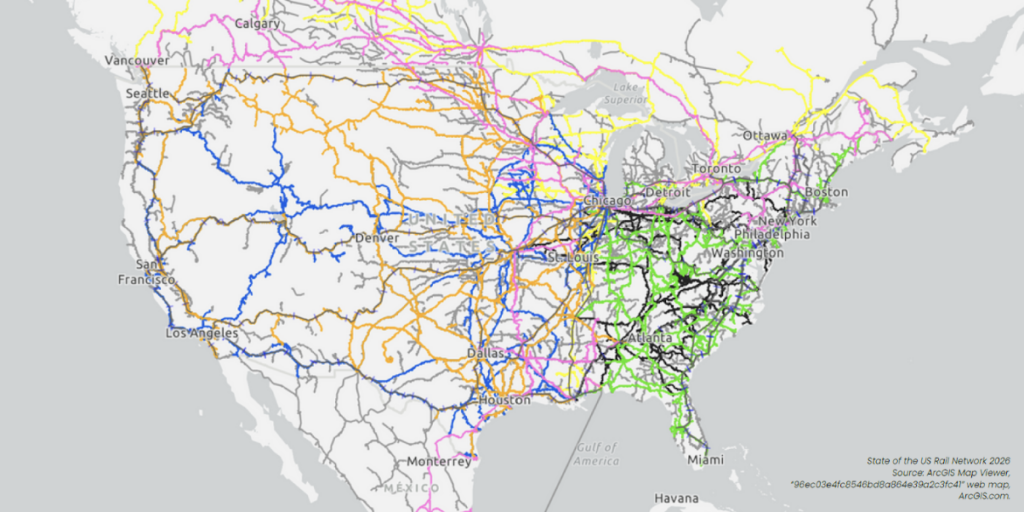
Given that no single railroad currently owns coast-to-coast transcontinental track in America, a lot of railborne freight moves this way By some estimates, roughly 45-50% of America’s carload volume, and 15%-20% of America’s intermodal volume moves via interline agreements. Most interchanges take place in Chicago, but St. Louis, Kansas City, Memphis, and New Orleans are also important interline junctions.
Merger/Acquisition of Other Railroads
Consider now that, with deep enough pockets, healthy ambition, and an accommodating regulatory environment, there is a bolder solution to your railroad’s problem of moving freight from A to B when you don’t own the tracks in between. You could just merge with another railroad that owns the tracks that you need. Such a bold move avails you of the acquired railroad’s network (pending government approval, of course).
There is a long history of such railroad mergers and acquisitions in the United States. In 1975, the US had 71 Class I railroads. But, at that point in railroading history, the industry was deeply unprofitable, and railroad bankruptcies were prevalent. Deregulation in 1980 gave American freight railroads the regulatory freedom that they needed to rationalize their networks and address their financial problems. As a result, by 2000, there were only 8 Class I railroads operating. Since then, merger activity has cooled, owing perhaps to both dwindling marginal gains to further consolidation, as well as a regulatory environment less inclined to invite monopoly power. Today, only 6 Class I’s remain – 5 if the pending UP-NS merger goes through.
In 2026, Why Merge When These Other Cooperative Options Exist?
This is the argument advanced both in words and in deed by the other Class I railroads. BNSF, CPKC, and CN have all filed their objections to the merger and its application packet with the Surface Transportation Board (STB). Seemingly in response to UP-NS’s merger announcement, competitors BNSF and CSX have also launched new joint services promising faster service through interline agreements, seemingly underlying the point that Class I cooperation can exist without merging.
Nevertheless, a few observations come to mind as potentially telling:
Timing: Railroad merger approval is subject to heavy government scrutiny, and in recent years, such approval has proven elusive. As we’ve said previously in our Market Consist, we think that UP’s Jim Vena saw a unique opportunity with the new Trump administration to win governmental approval for a transcontinental railroad, and has acted decisively to gain first mover advantage here. In our view, Vena’s bet will pay out, and the merger will ultimately win government approval. But keep in mind: this is still not a sure shot by any means. The STB’s decision to reject the application materials as incomplete (but “without prejudice”) in January 2026 was not, on its own, an encouraging signal. Nevertheless, Vena’s play is perhaps a once-in-a-career shot-on-goal that, if it lands, will fundamentally re-wire America’s freight networks, and cement Vena’s legacy in the grand history of American railroading
Market Power & Monopoly: The value of a railroad acquisition isn’t only in the track that it opens up to your trains. There is also value in consolidating power over the larger rail network that the merged entity covers. Keep in mind that all of the cooperative mechanisms discussed above only work if the neighbor railroad agrees to cooperate and let you into their space. This potential consolidation of power is precisely the worry among the UP-NS merger’s critics. Shippers are worried about losing competition for their business. Disparate industry groups, like chemical shippers, agricultural shippers, and the rail customer coalition have all been outspoken in their public warnings about the potentially damaging monopoly power that the merger could unleash.
US Import Shift from West to East: In an East-West transcontinental play like this one, it’s possible that a West Coast player like UP foresaw (as have others) the seismic shifts taking place in American freight markets in recent years. Several analysts, ours included, have been watching as inbound import volumes have started to shift from our country’s West Coast behemoth ports of Los Angeles and Long Beach, to expanding East Coast rail-capable options, including ports at New York & New Jersey, Savannah, Houston, and Charleston. A deep-pocketed West Coast railroad can capture some of that growing East Coast import business through interline agreements – but they could capture a bigger piece of it by owning all the track leading all the way up to America’s bustling and modernizing East Coast terminals.
The best solution to American railroading’s A to B problem is probably always contingent upon a lot of particulars: contingent upon the railroad owner’s competitive strategy and ambition at the time; contingent upon the specific freight move at hand; and contingent upon the policy landscape at the moment. In the case of the proposed Union Pacific and Norfolk Southern merger, none of us commentators and lookie-loos are actually privy to all of those important particulars and contingencies. And that’s okay. Personally, I love that in America, none of us have to know for sure what’s best. Every potential solution carries with it the opportunity – and the burden – to prove itself in a competitive marketplace for moving things from A to B – cheaper, better, faster.
May the best solution win.
About the Author

David Correll is the Director of Freight Market Intelligence at Telegraph. He has spent two decades in transportation and logistics with the US Department of Transportation, the US Department of Energy, the Massachusetts Institute of Technology, and Clark University. David brings his many experiences – and a little bit of wit – to help us break down some of the more nuanced challenges and opportunities facing American rail transportation.