read time • 9 mins
Railroading’s Transition to Telematics (Part Three): Consider the Choreography
Railroading’s Transition to Telematics (Part Three): Consider the Choreography
Telegraph’s four-part series looking ahead to the future of telematics-enabled freight railroading in the United States.
This is the third installment in Telegraph’s four-part blog series, Railroading’s Transition to Telematics (see Part 1 and Part 2). In each installment, we deep dive into the state of railcar telematics in the US, and make our case for a better future state.
“Dancers are instruments, like a piano the choreographer plays.” ― George Balanchine
Our previous installment asked: what’s in it for me? As a shipper, or a carrier, or a railcar lessor what do you get if you are an early adopter of railcar telematics? Where are the competitive advantages to railcar telematics innovators over their competitors who are, in comparison, flying blind?
This installment considers emergent properties of a fully digitally interconnected rail network. How can everyone benefit when over half of North America’s rail cars are communicating with each other, with a wider variety of digitally interconnected stakeholders, and with dedicated AI tooling, in real-time?
But first: consider the choreography.
A ballet, if you’ve never seen one, is a sight to behold. Even if you don’t give a rip about classical music, or about highbrow dancing, there’s not a freight logistician on this planet who couldn’t learn something from watching the way that the troops of costumed ballet dancers move gracefully around their tiny stage in perfect coordination. Every performance is like the simultaneous landing of dozens of sequenced airplanes on to one tiny airstrip. It’s like all of the forklifts in the warehouse, all finding elegant and arched pathways to their assigned pallets without interruption. A well-choreographed ballet is like a murmuration of soaring starlings, making and re-making their collective shapes in the air through naturally synchronized and equidistant spacing. It’s everything in its right place, every time.
In other words: it’s nothing like real life – and nothing like day-to-day freight railroading. Rather, ballet is art. And, for forward-thinking and imaginative railroaders, ballet dancers and murmurations of starlings can represent an aspirational choreography of telematics-enabled railcars autonomously directed and sequenced by an intelligence beyond even our own towards greater network fluidity, efficiency, safety, and security for everyone. Below are some examples of how we see widespread adoption of railcar telematics enabling this beautiful choreography.
Waze for Trains
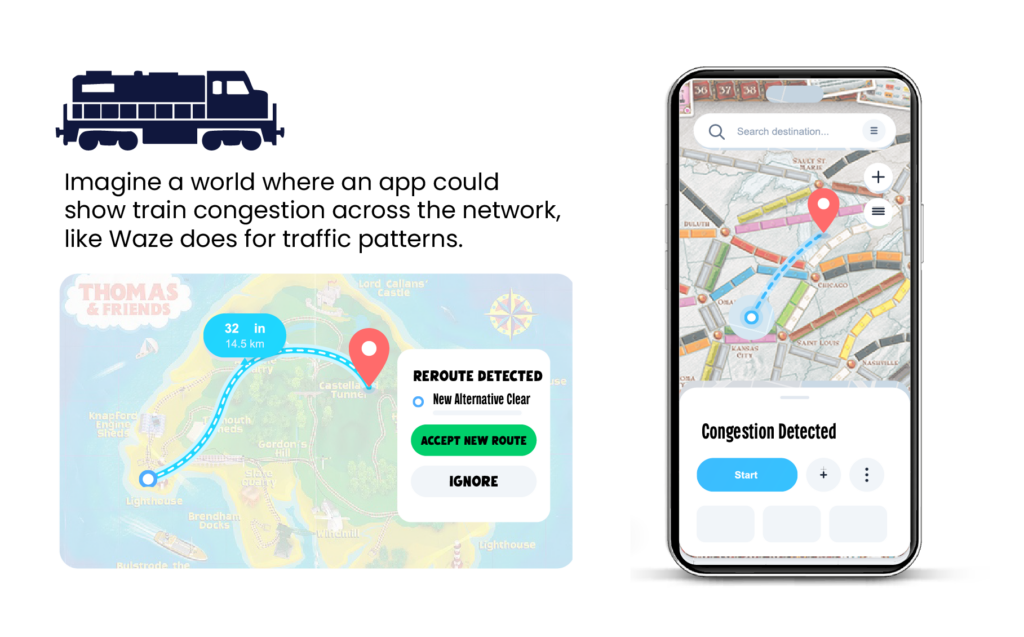
In June 2013, Google Maps bought the mapping app Waze for an estimated $1bn. What did Waze have that Google maps wanted? One big thing was Waze’s crowd-sourced congestion detection and reporting system.[1,2] Unlike other telematics-enabled mapping software at the time, which performed the obviously important function of plotting a vehicle along its route and providing turn-by-turn directions, the engineers at Waze had developed a way to leverage the telemetry data already built into thousands of motorists’ smart phones in order to detect when and where road traffic was slowing down. This crowd-sourced network fluidity data then colored users’ maps to indicate congestion observed along the route, and with time, even prompted automatic re-routings to help other drivers circumvent these delays. Of course, this kind of choreography is now commonplace among most smartphone-based mapping systems.
To achieve this choreography, Waze and Google needed a critical mass of users. Crowdsourced congestion observations were not possible until enough users were sharing enough data to identify problems, and then to direct the detours. As we previously discussed, approximately 2.5% of North American railcars are currently equipped with onboard telematics devices. But, imagine how rail network congestion could be detected and circumvented if ½ or more of North America’s railcars were broadcasting their real-time trajectories, and leveraging artificial intelligence to find optimal rerouting. See our vision below.
Air Traffic Control for Interchanges
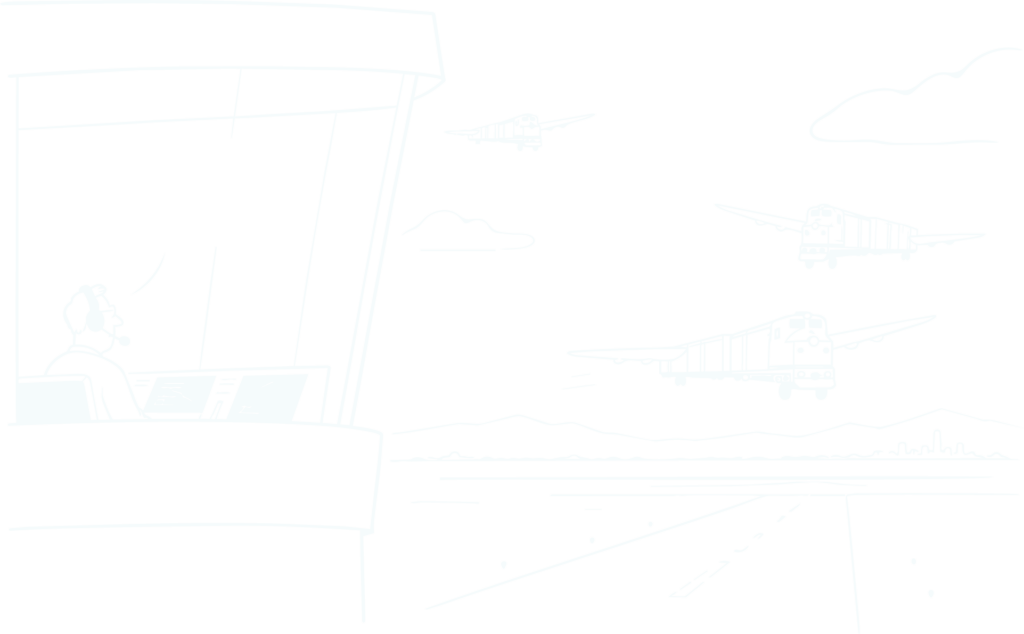
There exists an important logistical similarity between trains and planes. That is: both modes come together at network nodes where their cargo (people or freight) can enter and exit the system and make their connections. At these nodes (airports and railroad junctions), resources are scarce. And even the best made plans for allocating space and resources are easily disrupted by the many deviations from plan that can arise in the real world.
In aviation, air traffic controllers have developed generations of algorithms and heuristics that systematize the routing of planes to runways. Air traffic controllers can take into account wind conditions’ influence on takeoff and landing trajectories, gate availability, and even the amount of fuel left in each inbound airplane in order to match aircraft to busy runways and ground crews.
Of course, to achieve this choreography, air traffic controllers need information from all of the planes – not just a small subset of them. The air traffic controllers need to know the real-time position, itinerary, and contents of every arriving and departing aircraft. What if we had the same kind of choreography at our busiest rail hubs? Imagine a world where telematics-enabled choreographers at rail yards and terminals in Chicago and St. Louis know with certainty what is coming and going, in real-time, and can automatically align and re-align their resources accordingly to maximize throughput and minimize delays for everyone.
Safety, Service, + Security
As we noted in our previous installments of this series, to fully grasp the potential of onboard railcar telematics, it is important to remember that telematics devices are sensors capable of capturing more than just geolocation. Telematics devices can also capture information about the health of the railcar, as well as its contents. Imagine a world where real-time nationwide rail system health and railcar diagnostics are accessible to every interested stakeholder, problem-solver, and entrepreneur. In such a brave new world, we see beneficial implications for safety, service, and security for everyone along North America’s rail network.
Safety
Railcar derailments are potentially very dangerous events. As was the case with the most recent major derailment in East Palestine, Ohio in 2023, even the smallest components, when they break down, can cause catastrophic damage for surrounding communities and stakeholders.
One particularly vexing issue here is how and to whom railcar emergency sensors distribute their readings. Presently, signals from wayside track detectors are distributed directly to the operating railroad and to the train crew as system alarms when an at-risk piece of equipment happens to pass by a track-side detector. However, with widespread telematics adoption, nationwide railcar equipment health could instead be continuously monitored, and pertinent alerts could be digitally distributed to, among other stakeholders: regional law enforcement agencies, local health and safety professionals, and other first responders in order to orchestrate preventative stoppages, and when needed, choreograph timely community-based disaster response.
Service
When we know where the railcar malfunctions are happening, we also know where in the country future servicings will be required, and what type of replacement parts and tooling will be needed. Telematics data from all of the railcars traversing America’s rail network could be leveraged to more efficiently identify sites for railcar maintenance shops. Moreover, by adding predictive intelligence layers to these telematics datasets, rail car service providers could even prestock their shops for anticipated servicing needs, thereby reducing service lead times, and keeping the freight network fluid for everyone.
Security
Freight theft has grown in recent years, prompting, among other things, the creation of new federal resources for protecting America’s in-transit freight.[3] Increasingly, freight thieves are acting as organized groups, meaning that – just as with America’s battles against other types of organized crime – data analysis can be key to identifying the patterns that crack the case. High-fidelity, time-stamped railcar telematics data, paired with digitally-broadcasting sensors detecting tampering or unauthorized openings could instantly alert authorities – and possibly nearby traffic cameras and security cameras to criminal activity, making freight conveyance safer everywhere and for everyone.
Consider the Choreographer(s)
These use-cases all point to the many system-wide benefits that could result from knowing where the majority of America’s railcars are at any time, as well as information about each car’s mechanical health and cargo status. When adoption is sufficiently widespread, the opportunities imagined here – and likely many more – all become possible. But who will do this work? Who stands by ready to engineer and deliver ideas like Waze for Trains, or Air Traffic Control for Interchanges, and/or the other projects imagined in this piece and beyond?
Obviously, at Telegraph, we come to this with our own inspirations, and designs for our own contributions. But, more broadly, the beauty of a ballet, and perhaps the free market economy writ large, is that no single star can ever really steal the show. No single and omnipotent authority can ever marionette every dancer’s – or every entrepreneur’s – contribution to the whole.
Rather, real achievement only ever emerges in concert. The dancers move in concert with one another, and with the symphony in the pit beneath them. Similarly, we believe that, going forward, as telematics adoption expands from the innovators’ phase to the early and late majority adopters, railcar owners will develop telematics-enabled solutions in concert with the coders and the technologists who bring good ideas to life. The railroads and their shippers will find new telematics-enabled white space within which to brainstorm new and coordinated solutions in concert with one another. And you, dear reader, we hope will continue to imagine railroading’s digital future in concert with us.
Please reach out when you’re ready to dance.
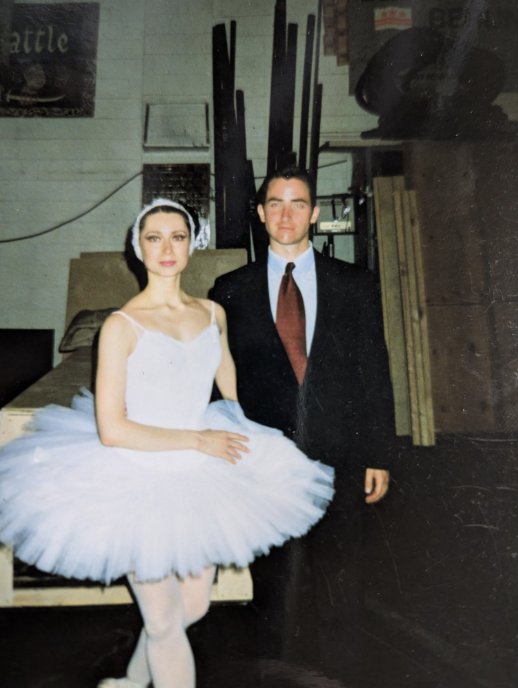
Choreographer in training: The Kennedy Center for the Performing Arts 2002
Pictured: David Correll and Prima Ballerina
Footnotes
[1]https://www.autoweek.com/news/a2153701/finally-google-maps-gets-waze-speed-trap-avoidance-features/
[2]https://www.theguardian.com/technology/2013/jun/11/google-buys-waze-maps-billion
[3]https://www.congress.gov/bill/119th-congress/house-bill/2853/text
About the Author

David Correll is the Director of Freight Market Intelligence at Telegraph. He has spent two decades in transportation and logistics with the US Department of Transportation, the US Department of Energy, the Massachusetts Institute of Technology, and Clark University. David brings his many experiences – and a little bit of wit – to help us break down some of the more nuanced challenges and opportunities facing American rail transportation.