read time • 10 mins
Railroading’s Transition to Telematics (Part Two): The First 2.5%
Railroading’s Transition to Telematics (Part Two): The First 2.5%
Telegraph’s 4-part series looking ahead to the future of telematics-enabled freight railroading in the United States.
This is the second installment in Telegraph’s four-part blog series, Railroading’s Transition to Telematics. In each installment, we deep dive into the state of railcar telematics in the US, and make our case for a better future state.
We Are Here: Innovators + Early Adopters
Knowing the location of a railcar is obviously helpful. But in the current day and age, simply knowing where an asset is can leave something to be desired. This is especially true given that off-the-shelf technology already exists to capture additional pertinent information about your freight. With railcar telematics sensors, this additional pertinent information can include: your freight’s current temperature and security status, the mechanical health of the railcar asset, the railcar’s load status, and much more, some of which we will discuss below. This second installment of our four-part blog series on the future of telematics-empowered freight railroading lays out the opportunities available to today’s early adopters of telematics. We’ll call today’s telematics adopters the “innovators”, and we’ll enumerate the advantages that we see accruing to today’s railcar telematics innovators, even when adoption is limited only to pilot-scale testing fleets.
(No) Shots Fired!
Our last installment in this blog series argued that recent history shows us that once a forcing mechanism is imposed, a complete transition to widespread railcar telematics could be achieved in as little as four years. That’s how long it took trucking to transition to telematics technology. That’s how long it took railroading to adopt its 1990s (and current) geopositioning technology known as carload location monitoring (CLM). And so, we argued, that perhaps someone (maybe the federal regulators, maybe the American Association of Railroads) might fire their starter’s pistol and impose a new forcing mechanism on our industry, thereby ushering in the next great technological leap forward in American freight railroading.
And yet, no shots fired. No forcing mechanism in place.
But, don’t be deceived. Things are happening.

In Dr. Frank Bass’s classic and time-tested mathematical model of new product adoption, a new product takes hold across the marketplace in the same way that Ernest Hemingway once described how a man goes bankrupt, “gradually, then suddenly”.[1] Bass’s “Diffusion Model” uses differential equations to describe these same dynamics.
Mathematically, Bass’s diffusion of innovation model describes how new products pick up slowly at first, as brave early adopter experiences accumulate, and then can rapidly proliferate across the marketplace, if those first adopters’ experiences are sufficiently positive, and – crucially – if these happy first customers sufficiently evangelize.
In Bass’s model, a product’s brave first users are called the “innovators”, and they are mathematically defined as the first 2.5% of market participants willing to take a chance on a new technology.[2]
According to recent announcements from the Railpulse coalition, around forty thousand railcars have so far been onboarded to the RailPulse railcar telematics platform. Given that there are roughly 1.65mn railcars operating in the United States, that works out to about 2.5% of America’s railcar fleet – exact alignment with the “innovators” phase of Dr. Bass’s famous diffusion model. We are here.
So how are the “innovators” innovating?
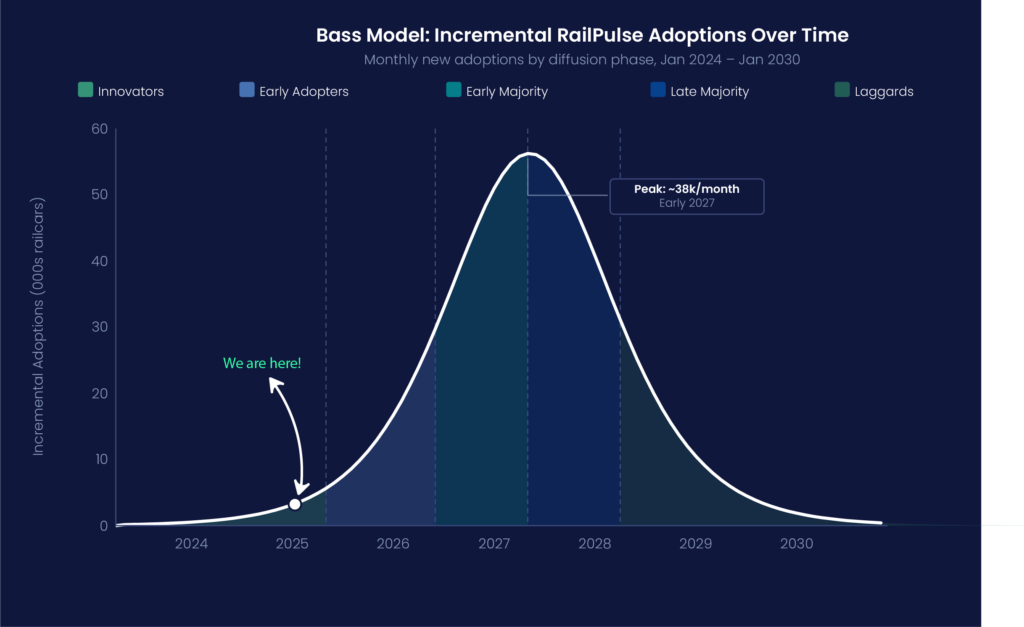
Figure 1: Bass Diffusion Model with incremental adoption predictions and groupings.
Real-Time Alerts + Enhanced ETAs
The first thing to understand when comparing railroads’ existing geolocation technology to telematics is the step change improvement in resolution. Typically, the current CLM system reports a train’s location data approximately 5 or 6 times per day as the train passes trackside RFID readers. In some cases, these RFID pings are communicated with a lag of up to 6 hours.
Compare that with today’s telematics devices, which deliver a railcar’s satellite-identified geoposition 40 to 50 times per day in real time. This implies an almost 10-fold increase in resolution! This higher resolution data substantially improves early adopters’ understanding of where their railcars are at any given moment. On our platform, railcars that ping outside of the expected route can generate instant alerts (straight to your phone, if you like!), giving you an immediate heads-up when your railcar is unexpectedly out-of-route.
Even more importantly, higher resolution data offers better insights into when railcars will actually arrive at their appointed destinations. This telematics-enabled insight matters because, with the present CLM technology, it is not uncommon to observe a three to four day margin of error around even the most sophisticated railroad reported time of arrival. This wide variability carries with it real cost implications, including: the misscheduling of receivers’ materials handling resources and warehouse space, over-estimation of inventory requirements, and even production stoppages when time-sensitive freight fails to arrive on time.
In our own experimentation, we are currently blending CLM data with customers’ telematics data to feed our already outperforming telETA™ algorithms. We see potential to expand upon existing successes, allowing us to shrink our patented and industry-leading telETA margin of error down from roughly a day and a half to one day or less.
The Four D’s of Freight Rail: Demurrage, Detention, Delay + Disputes
However, in railroading, it’s not just about knowing when your railcar will arrive. There is also the vexing challenge of assigning blame and imposing fees on whoever caused that railcar to arrive later than expected. This is the often uncomfortable world of detention and demurrage, wherein the blame for delaying railcars is presently unartfully apportioned, and fines – sometimes reaching tens of thousands of dollars or more – are levied between shippers, carriers and their customers who would all otherwise much prefer to just get along.
Unfortunately, under the current 1990s-era CLM system, it is not always knowable who is actually responsible for delaying a railcar. Nor is it typically worth the time of all the parties involved to fully investigate each case of railcar delay. In effect, shippers often end up paying the sometimes hefty detention and demurrage invoices that they receive with little to no real opportunity for recourse. We recently sat down with a shipper who spent $655K in unplanned demurrage fees at a single facility in a single month.
Real-time, high-fidelity telematics data stands to change all of that for the better. Not only do onboard telematics offer a higher resolution digital trail of a railcar’s exact location, but they also open the door to user-defined digital geofencing. Geofences are invisible digital lines drawn on a digital map that can be triggered in the real world when real physical objects (like trains) cross a user-defined digital geofence (like arrival at rail yards). Tripping the geofence can trigger a timestamp, an alert, even a trackside image capture. These user-defined geofenced timestamps and event triggers stand to become the immutable evidentiary record needed to fairly and efficiently resolve demurrage and detention disputes with cold, hard, data.
Next-generation Freight Visibility + Management
Telematics devices are sensors. Of course, one thing they sense is location, as described in the examples above. But, depending on the type of device, railcar telematics sensors can also monitor, broadcast, and even manage other important freight parameters.
For example, at Telegraph, we built a software module on top of one early-adopter customer’s telematics sensors that give the freight owner real-time visibility into the temperature inside their refrigerated rail cars. The technology even allows the user to adjust the railcar’s internal temperature from any internet-connected device with the click of a button. This system also allows for real-time monitoring of fuel level in the refrigeration units, which offers an early and actionable heads-up before a refrigeration unit unexpectedly powers down for lack of fuel. This telematics-enabled intervention opportunity is especially important in the coming summer months, when in-transit food spoilage can be an expensive, and messy problem. Possibilities like this – and more – become realizable when the railcars are equipped with advanced telemetry sensors.

Figure 2: Telegraph’s telematics enabled, temperature-controlled Watchtower view
Asset Health Monitoring
But it’s not only the status of the freight that matters. The health of the railcar matters too. At present, sensors are installed along America’s rail network that take diagnostic readings of passing rail cars monitoring for real-time mechanical health of the rolling stock. However, these programs are not 100% reliable, as was evidenced in the 2023 tragedy in East Palestine, Ohio, when an overheated wheel bearing escaped timely detection and ultimately failed, causing a massive derailment and environmental disaster.
There are, of course, many responses to tragedy of that scale. One idea is to put more wayside detectors along America’s railcar tracks. Such efforts currently underway in Congress are perfectly understandable in a world with limited telematics adoption. But, what else could onboard railcar telematics contribute? Working with the most sophisticated telematics hardware makers, today’s telematics innovators are finding ways to monitor railcars’ wheels, brakes, and hatches in real time, with built-in on-board diagnostic monitoring. And, even more impressively, these telematics innovators are training machine learning algorithms to monitor that constant stream of railcar mechanical health diagnostic data, and then use it to suggest important predictive maintenance opportunities before disaster strikes – thereby potentially improving railroad safety and reducing operating costs at the same time.
What’s Next?

Figure 3: Diffusion model predictions for Railcar Telematics Adoption
If, dear reader, for a moment you will accept two key premises of this blog’s argument: (1) that the Bass diffusion model is a reasonable approach to predicting new product adoption, and (2) that today’s railcar telematics innovators are having a pretty good experience with their devices so far, and stand ready to evangelize, then it’s fair to ask: what does this tell us about the future of railcar telematics adoption in the United States?
To answer this question, we fit the Bass Diffusion equation to the Railpulse coalition’s publicly announced platform enrollment data to produce Figures 1 and 3 of this blog post. In Figure 3 , shown above, this approach suggests that 10% of America’s railcars could be equipped with telematics by 2027, 50% by 2028, and 80% to 90% of railcars could be equipped by 2029.
But will the telematics transition happen as Bass’ model predicts? Meeting these predictions would mean, on average, equipping an additional 40,000 rail cars per month through the end of the decade. Achieving that would not only be time consuming, but would come at a meaningful cost. It bears noting here that: (1) the recently released Build America 250 Act intends to create federal subsidies to reduce the cost of telematics adoption, and (2) we’ve moved at roughly this pace before.
In our next installment of our Telematics blog series, we will describe what happens to freight railroading in a brave new world where half or more of America’s 1.65mn railcars are digitally interconnected and communicating with one another and with dedicated AI tools and optimization algorithms.
Footnotes
- Ernest Hemingway, The Sun Also Rises (1926)
- The term “innovators” as applied here, and the other customer groupings named are actually borrowed from previous work by another scholar, Dr. Everett Rogers, on diffusion of innovation. Over time many lay-people like us have combined Bass’s math with Rogers’s vocabulary, as is presented here. Famously, this includes Geoffrey Moore’s influential book, “Crossing the Chasm”.
About the Author

David Correll is the Director of Freight Market Intelligence at Telegraph. He has spent two decades in transportation and logistics with the US Department of Transportation, the US Department of Energy, the Massachusetts Institute of Technology, and Clark University. David brings his many experiences – and a little bit of wit – to help us break down some of the more nuanced challenges and opportunities facing American rail transportation.