read time • 12 mins
Railroading’s Transition to Telematics (Part Four): The Railcar Telematics Stag Hunt
The Railcar Telematics Stag Hunt
Thus far in our four-part blog series on railroading’s pending transition to telematics, we’ve made several points. First, that a transition to full-fleet telematics could happen relatively quickly – in four years. We know this because, as laid out in our first installment, “A Lot Can Happen in Four Years”, similar transitions have happened in our industry at exactly that pace twice in recent history. Second, in our post, “The First 2.5%” we argued that tech-savvy early adopters of railcar telematics are already enjoying competitive advantages, including higher fidelity visibility into their freight’s geographic position and condition, more accurate ETAs, and even new and advanced in-transit management capabilities, like live cold-chain control. Then, in our third installment, “Consider the Choreography,” we posited that even greater returns on railcar telematics investments will begin to accrue when half or more of America’s 1.65mn railcars are digitally interconnected and communicating with one another, and with dedicated AI tools and optimization algorithms. As we imagine it, full-fleet railcar telematics adoption could unlock: adaptive network congestion avoidance, predictive maintenance, predictive materials handling deployment, and even safer and more secure freight conveyance through data-driven AI-enabled pattern matching criminal investigations.
In this fourth and final (for now) meditation on this theme, we wrestle with the all-important question: if full-fleet railcar telematics adoption is really such a great idea, then why isn’t it here yet? Of course, the numbers matter here – especially the big ones with dollar signs attached. However, herein we will argue that the big ideas matter even more.
The Numbers - Especially the Big Ones with Dollar Signs
A first primary obstacle to full-fleet railcar telematics adoption is the cost. No one is up for spending big money frivolously. Let’s assume, conservatively, that equipping a railcar with an off-the-shelf telematics device costs approximately $2,000 per car.[1] With an estimated 1.65mn railcars circulating North America right now, equipping all of them would cost something like $3.3bn.
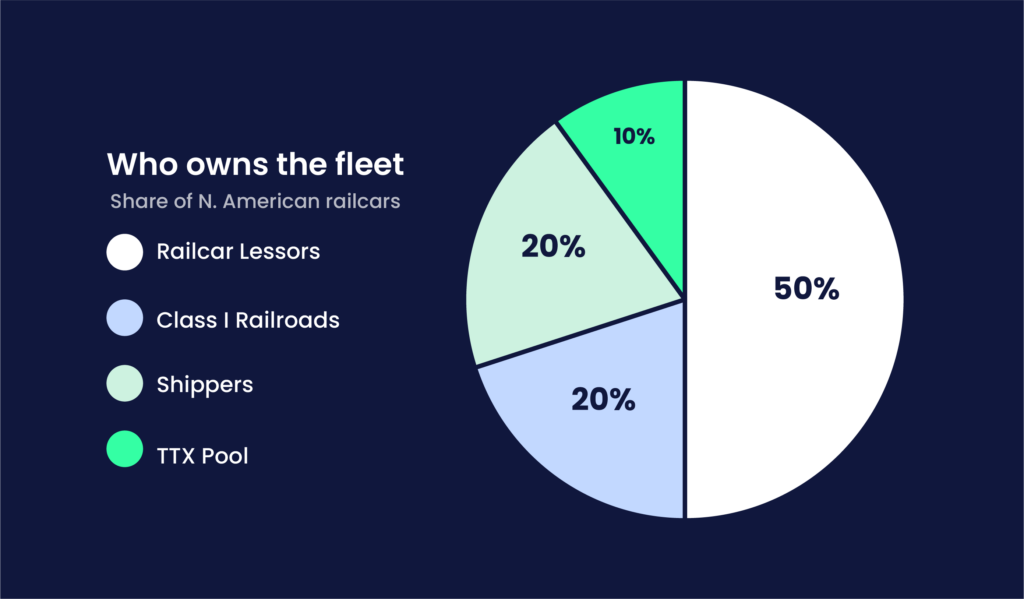
So, who foots this bill? Consider that ownership of these 1.65mn railcars is roughly split across railcar leasing companies (~50%), railroads (~20%), rail shippers (~20%) and the TTX railcar pool (~10%). From two of these groups, leasing companies and railroads, we can infer from their publicly available financial reporting how much they spent on equipment and maintenance in 2025. We estimate that railroads spent about $2.86bn, and that the railcar leasing companies spent about $3bn.[2] The table below compares these estimates to each owner type’s prorated-by-ownership share of the total $3.3bn cost of a full-fleet upgrade to telematics.
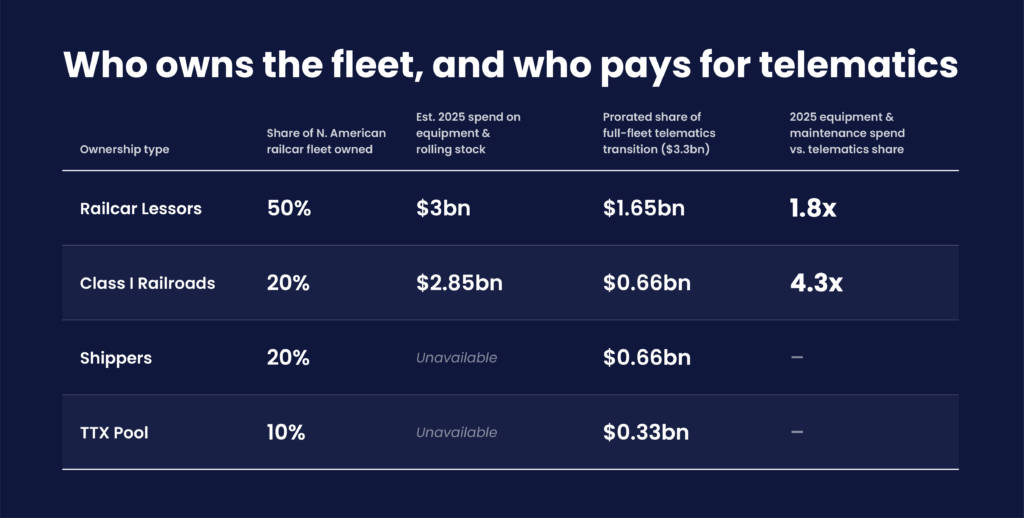
The obvious implication of this exercise is that, although $3.3bn is a very large number, it is not an impossibly large number. The major players in American railcar ownership already spend 2x to 4x their prorated-by-ownership contribution to this cost every year on railcar equipment and maintenance. Moreover, consider that: (1) a transition, once begun, is likely to be spread out over four years or more – not completed in one year; and (2) the federal government has already drafted legislation that would subsidize railcar telematics adoption beginning with tank cars in 2027 (more on this below). In our estimation, yes these capital outlays are very large, and by virtue of that size, represent a real impediment to full-fleet adoption – but they do not represent a blocker. Even if only these two ownership types (railcar lessors and railroads) undertook the transition to telematics, their combined fleets would account for roughly 70% or more of North American railcars, and thereby unlock the new data-driven network-enhancing capabilities that we envisioned in our post, “Consider the Choreography”.
The Stag Hunt
In our view then, the real blocker is not finding the $3.3bn dollars. That money and more is spent every year by the relevant actors on similar expenses. Rather, the challenge lies in designing a system with incentives capable of derisking the investment in the telematics transition for railcar owners, shippers and technologists, alike.
A “Stag Hunt” is a problem of the human condition going back to 18th century French philosopher Jean-Jaques Rousseau[3]. The seed of the “Stag Hunt” problem is this: A small and primitive hunting party goes into the woods to hunt wild game for the village. If the members of the hunting party work together and assume shared risk and shared reward, they can hunt a big “stag”, which, if successful, results in a very large prize that benefits them and the entire village (think fully digitally interconnected and AI-optimized railroading experience as we’ve described in this blog series). Because of the size of the stag, the hunters are only able to reap these prodigious rewards by trusting one another to fully commit to collaboration, and to equitably sharing the risk of the hunt. Independent hunters have no chance to fell a large stag on their own. Alternatively, each hunter can go their own way, and hunt a much smaller hare, which is surely gettable (think continuous incremental cost reductions at the margins that reduce operating ratios).
In game-theoretical terms, shippers, carriers, railcar owners, railcar lessors and technologists working together to hunt the larger, but riskier, stag would represent this game’s “payoff dominant” strategy. Alternatively, solo-hunting the smaller hare is called the “risk-dominant” strategy. In this framing then, our interconnected rail supply chain’s reticence to fully invest in full-fleet telematics is akin to hunting only hares and missing the feast of the stag. To us, this is hard to watch from the sidelines . Because, as affiliated techno-optimist members of the freight railroading and supply chain communities, we would very much like to see freight railroading evolve beyond today’s information-siloed 1990s-era RFID based geolocation systems and to realize the modern digitally interconnected and algorithmically-optimized network serves the needs of the modern supply chain. This is precisely what we’ve been imagining all along in this blog series. In essence, we joined this party to hunt that stag.
But, as technologists and developers, it is of course foolhardy for us – – to expect that the railcar owners and shippers in our hunting party ought to shoulder the full cost and risks of the telematics transition themselves, especially when the benefits so clearly accrue beyond any single firm’s borders. If the rest of us want to incentivize railcar owners and shippers to play their payoff-dominant, hunt-the-stag strategy, then we must incentivize it by de-risking the stag hunt for everyone. As you will read below, earnest efforts are underway, but we recommend that additional de-risking strategies be adopted too.
Earnest Efforts Underway
At Telegraph, we are strongly supportive of provisions in House Resolution 8870 The Build America 250 Act, which sets aside subsidies for railcar owners to invest in railcar telematics, beginning with tank cars. Obviously, funding like this essentially de-risks the stag hunt by lowering the cost to equip certain railcars with telematics. At the time of writing, we believe it possible that these subsidies will survive reconciliation with the forthcoming Senate version of the same bill and become federal law in 2027 or 2028.
We are also strong proponents of the RailPulse coalition – a consortium of rail industry players who came together in 2020 to standardize and centralize railcar telematics data so that forward thinking operators will be able to use this new data to further realize the true value of a diverse transportation portfolio which includes rail.. This important effort stands to de-risk the stag hunt by coordinating data formatting standards and reducing the cost and frictions of data access for technologists and solutions providers.
The Crux of A Stag Hunt is Trust
Efforts like the telematics subsidies in the Build America 250 Act and the RailPulse Coalition certainly help. But, if these efforts were enough on their own, we think that today, more than 2.5% of North American railcars would already be equipped with telematics units. The issue is that neither government telematics subsidies, nor the early efforts, address the root cause of all stag hunt problems: trust. Since the time of Rosseau, the allegory of the stag hunt has always been about illustrating and solving problems of trust amongst interdependent actors when working towards a greater good. Trust that none of the hungry or self-interested hunters will defect to instead hunt a passing hare for themselves, and thereby unbalance the shared risk and reward of the hunt.
In the context of the $3.3bn transition to telematics: railcar owners’ trust that shippers will elect to pay for the innovations enabled by telematics-equipped railcars; for the shippers, trust that that all these wonderful and imagined benefits will be realized into actionable and commercially viable solutions for them; and for everyone, trust that a critical mass of interconnected actors will concomitantly buy-in and integrate their systems in order to unlock the “choreography” that we envisioned in part three of this series.
In addition to the efforts already underway, how else might we solve the problem of trust on the telematics stag hunt? Below are two ideas with rather interdisciplinary inspirations that we haven’t seen adopted yet in modern freight railroading, but that we believe could meaningfully accelerate railcar telematics adoption; and a third more obvious, but less likely, solution that may nevertheless be forthcoming in 2027.
1. De-Risking For Railcar Owners: Conditional Commitment Network Alliances:
Consider that when a new oil and gas pipeline is built, the first decade of project development is often spent collecting conditional commitment signatures from potential users of the pipeline. Only once a sufficient collection of future customers has signed commitment agreements, will the asset-owners undertake the time-consuming and expensive project of pipeline construction. Similarly, influential shipper groups and network operators comprising regional supply chain linkages, or a specific industry’s freight originators, consignees and receivers, could enter into conditional telematics commitment agreements with their rail carriers and/or railcar lessors to support next-generation telematics-enabled railroading along their heavily trafficked lanes. This kind of conditional commitment alliance would de-risk the stag hunt for railcar owners by ensuring that customers are essentially on pre-order for telematics-enabled railroading. It would also de-risk the stag hunt for everyone else by ensuring that the critical mass necessary to realize network coordination effects is assembled before investment. An obvious first stop laboratory for such a strategy is the chemicals industry and tanker car traffic via busy Gulf Coast export terminals, where traffic is high, the commodities are high-value and sometimes hazardous, and the initial cost of the telematics devices could be offset by pending telematics subsidy legislation.
2. De-Risking For Shippers: Shipper-Centered Niche Speciation:
Consider the fork-in-the-road once faced by all evolving life forms: am I a generalist species or a specialist species? The generalist species is adaptable to any environment, any conditions, and any mix of food sources. Think of a cute little raccoon rifling its tiny, grubby paws through your trash. On the other hand, a specialist (or “niche”) species survives only within the narrow confines of one particular environment where it thrives. Think of a pot-bellied panda bear bingeing on bamboo. Both species are black and white and adorable. But, these two species have navigated life and evolution with very different survival strategies. What if, instead of imagining a racoon’s generalist future for railcar telematics solutions, as is the case today where telematics hardware and software developers work toward universal solutions for every shipper type, we instead follow the niche speciation path of the panda bear? In our work with rail shippers, we observe that cold chain customers’ problems are different from petrochemical shippers’ problems, which are different from bulk grain shippers’ problems. Shipper-centered hardware/software telematics development speciation stands to de-risk the telematics stag hunt for shippers and technologists alike by focusing today’s time and energy on today’s most important pain points, thereby expediting the timeline to commercially viable industry-relevant solutions and each side’s return on their investment.
3. De-Risking For Everyone: Mandate the Stag Hunt:
Finally, one obvious solution to the problem of trust amongst the hunters is to mandate hunting the stag. That is, to mandate adoption of railcar telematics technology from the top-down. This is the solution undertaken by the federal government with the telematics mandate on trucks which went into effect in 2019; and the American Association of Railroads with the RFID geolocators mandate on trains in 1991. We documented these histories in our post, A Lot Can Happen in Four Years, but also argued that we do not believe that in the current environment there is appetite for, or sufficient political will to, support a new technology mandate. However the tides in Congress changed meaningfully in November 2026, and the legislative vehicle with which to impose such a mandate is still under development by Congress. Although a railcar telematics mandate still feels unlikely to us at present,, we may now be only one more big derailment away from changing everything top-down, all over again.
Farewell For Now
We believe that you can’t hold back American innovation any more than you can hold back spring. Eventually, it will always prevail. Whether or not the transition to full-fleet railcar telematics happens by virtue of all, some, or none of the ways that we’ve imagined herein matters far less than that the overdue upgrade itself actually happens, and that America’s rail-served supply chains transition to the modern telematics technologies that will allow our interconnected freight rail network to reach its full potential for speed, service, safety, and cost.
We joined this party to hunt that stag.
Footnotes
[1] Long, Patty. Written Testimony of Patty Long, President Railway Supply Institute before the Surface Transportation Board, Docket No. EP 775 “GROWTH IN THE FREIGHT RAIL INDUSTRY”, September 16-17 2024.
[2] This estimate is very imprecise and based on the Class I railroad’s filings with the SEC and the STB, and available 10-K reporting from large railcar lessors.
[3] Skyrms, B., 2004. The stag hunt and the evolution of social structure. Cambridge University Press.
About the Author

David Correll is the Director of Freight Market Intelligence at Telegraph. He has spent two decades in transportation and logistics with the US Department of Transportation, the US Department of Energy, the Massachusetts Institute of Technology, and Clark University. David brings his many experiences – and a little bit of wit – to help us break down some of the more nuanced challenges and opportunities facing American rail transportation.